
32. How to Grow Your Community Without Hustling Harder (2026)

Updated: Sep 15
TL;DR: The fear isn't launching a community. It's launching and hearing nothing. But sustainable community growth isn't about more tactics, more channels, or more hustle. It's about having the right foundation, the right funnel, and the right data. This post walks through the three stages of a community marketing funnel, the Prospecting Audit framework, and a real client case study where conversion rates jumped from 17% to 61% after one strategic shift.
In my workshops, I always ask people who are getting ready to launch: what's the worst thing that can happen when you launch your community? Turns out we all share the same bad dream.
You open the doors to your brand new, well-designed, thoughtful community. You've worked on it for months. You're proud of it.
And then… crickets.
No members. No engagement. No momentum.
Or even worse — one person shows up.
I have been there. And it is a very particular kind of painful.
Here's what I've learned after years of building communities — both for my own business and for my clients: the answer to that fear isn't hustling harder, throwing money at ads, or trying every growth tactic that found you in a doom scroll at 11pm.
Community growth is the result of strategy, structure, and sequence.
This is the final episode of Dear Bri Season 3, and I saved this topic for last on purpose. By the end of this post you'll have the three-stage community marketing funnel I use with every client, the Prospecting Audit framework you can run yourself, and a clear picture of where your growth is actually getting stuck.
⏳ Timestamps:
00:00:00 | The fear every community builder shares
00:01:57 | The foundations every community needs before growth
00:04:14 | Community marketing funnel stage 1: Awareness
00:06:07 | Community marketing funnel stage 2: Nurture
00:07:39 | Community marketing funnel stage 3: The Close
00:10:09 | A real community growth case study
00:13:11 | How to run a Prospecting Audit [Framework]
00:15:31 | Full recap
Before You Focus on Community Growth, Check These 4 Foundations
I put this episode last in Season 3 on purpose.Because if you haven't done the foundational work from Episodes 1 through 6, jumping straight to growth tactics won't work — or it will work, but you'll be grinding 100x harder for worse results than if the foundations were solid.
Here's what needs to be in place first:
Your community model. There are four types of communities, and most of the confusion I see comes from someone operating the wrong model for their business. (Season 3, Episode 1)
Your community platform. If your platform feels like a chore to manage, your members will feel that friction too. And if you're not excited about the space you've created, you will — consciously or unconsciously — find every reason to avoid marketing it. (Season 3, Episode 3)
Your community pricing. Pricing is intrinsically tied to growth. The myths and blocks you carry about pricing your community can absolutely be the thing holding back new members. (Season 3, Episodes 4 and 5)
Your community engagement. If your current members aren't engaging, adding more members won't solve the problem — it will amplify it. Growth makes what's already there louder. (Season 3, Episode 6). I cannot think of a single client who has come to me struggling to grow their community who didn't have work to do in at least one of these areas. If and only if these foundations are in place — then it's time to focus on growth.
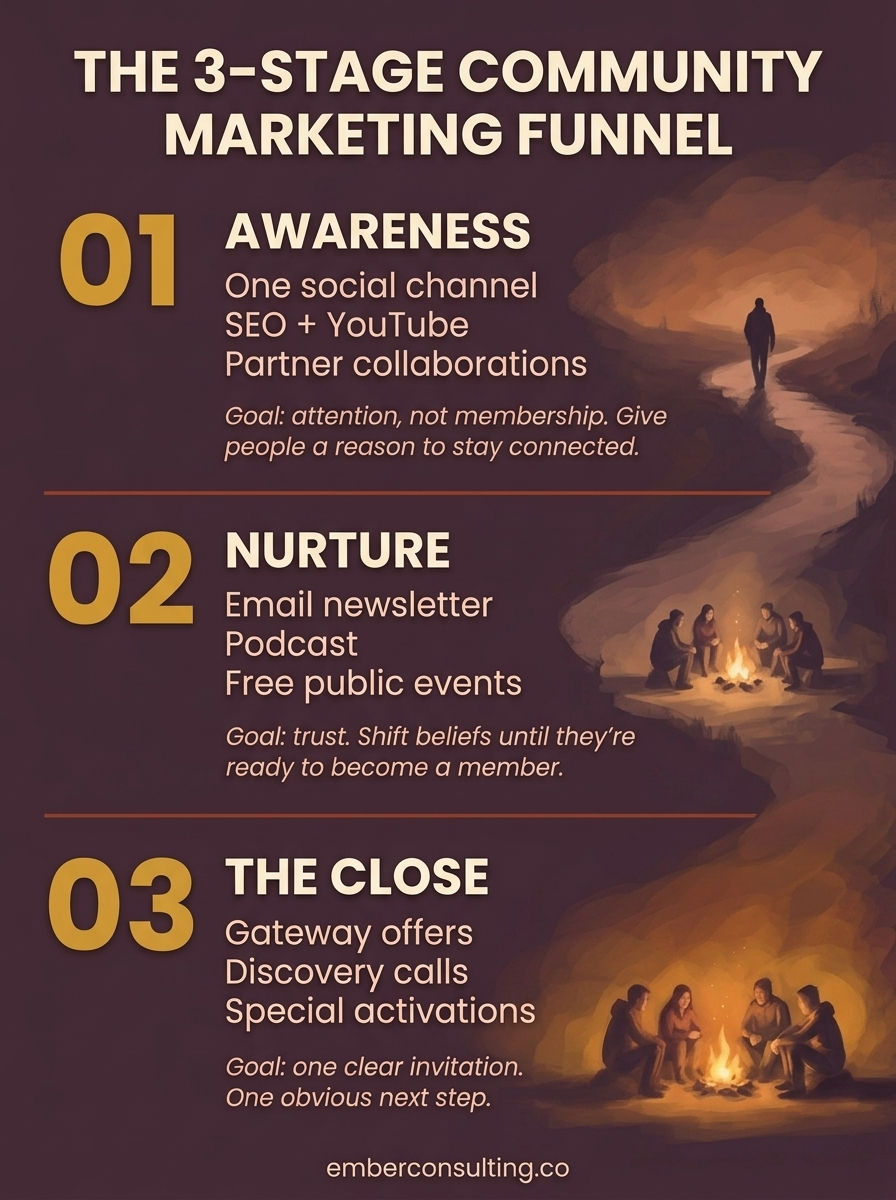
The 3-Stage Community Marketing Funnel
Once your foundation is solid, growth comes down to understanding your marketing funnel. In its simplest form, it has three stages.
Stage 1: Awareness
Awareness is where people discover you — where someone goes from never having heard of you to becoming part of your audience.
The goal here isn't membership. It's attention.
Top-of-funnel tactics I recommend:
One social channel. Not two. Not three. One. Pick the platform where you genuinely want to spend time AND where your ideal members naturally hang out. Once you have a million followers we can talk about expanding. Until then — one.
SEO and YouTube. I categorize YouTube under SEO rather than social media because that's how it functions — people are searching, not just scrolling. This is one of the most sustainable awareness channels available to community builders.
Partner collaborations. Getting in front of someone else's audience: hosting a workshop for another community, guesting on a podcast, co-creating content with someone whose audience overlaps with yours.
Being genuinely helpful inside other communities. Not promotional — helpful. There's a full guide on this linked below.
One important note: when you get in front of new eyes, you need to give people a compelling reason to stay connected. That's where a lead magnet comes in — something free and valuable that earns their continued attention and ideally their email address.
Stage 2: Nurture
The middle of the funnel is where your audience gets to know you, like you, and trust you — and where beliefs slowly shift so people become the type of person who's ready to become your member.
People rarely become members the first time they encounter you. They need time. They need evidence that you're the right guide for the journey they're on.
Nurturing tactics I recommend:
An email newsletter. Non-negotiable. It keeps your audience warm between launches and between decisions.
A podcast. This is personal for me: when I launched Dear Bri Season 1, my conversion rate from discovery call to closed client went from 12% to 40% — because after every discovery call, I sent people off with a podcast episode as homework. A podcast is one of the most powerful nurturing mechanisms I've seen for service-based businesses.
Free public events. Workshops, webinars, virtual gatherings — experiences that let people feel your teaching before they commit to anything paid.
Stage 3: The Close
The bottom of the funnel is where someone moves from being passively in your audience to actively becoming a member. This is where you give them a clear, compelling reason to join today — because they're ready.
Bottom-of-funnel tactics I recommend:
Gateway offers. A lower-commitment, lower-cost first step that lets someone experience working with you before joining your full community. More on this in the case study below.
Active lead generators. Discovery calls, intake processes, direct invitations.
Special activations. A bootcamp, a challenge, a mini-program designed specifically to move people across the threshold.
What I actively don't recommend:
Discounting your community
Offering a free trial
Offering a free, limited membership
We went deep on why in Episodes 4 and 5 — the short version is that each of these undermines the positioning and commitment that makes a paid community work.
Community Growth Is Not About More Tactics
Here's the part most people miss:
Growing your community is not about introducing new tactics, discovering a new channel, or adding more to your plate. It's about finding the one or two things already working at each stage of your funnel — and investing more resources into what's working.
If you're just starting out, you'll need time to experiment. Take it slow. The biggest mistake I see is people trying too many strategies at once and doing none of them well. But if you've been in business for a while? You have data. You have patterns. You just might not be looking at them the right way yet.
Which is exactly what the Prospecting Audit is for.
Real Community Growth Case Study: LaToya
LaToya joined me for a Recalibration Intensive — a full day together online where community builders reflect on what's working, what isn't, and walk away with a concrete plan for the next three to six months.
When LaToya came in, awareness wasn't her problem. Discovery calls were happening. Interest was there.
But something was getting stuck at the bottom of her funnel. She was struggling to convert those calls into paying members.
When we dug in, the issue was positioning — not visibility.
She had positioned her community as the first step in her client journey. But when we looked at her actual members and what served them best, her community worked much better as the last step: a place for accountability and ongoing support after the foundational work was already done.
Once we repositioned, we zeroed in on her gateway offer — that first stepping stone to working with her — and modified it in four ways:
Focused on diagnosing the problem, not solving it yet
More affordable — easier to say yes to
Way easier for her to deliver
Way less for her members to digest at once
This gateway offer became a no-brainer for prospective clients — and something LaToya could sell with genuine confidence. Her energy on discovery calls shifted noticeably. She was clear, excited, and sure of herself in a way she hadn't been before.
Before these changes, her discovery calls converted to paying members at 17%. Already not a bad number. After?61%. And none of that would have been visible without first running a proper Prospecting Audit.
How to Run a Prospecting Audit
The Prospecting Audit is a simple framework I use inside the Recalibration Intensive — but you can run your own version right now.
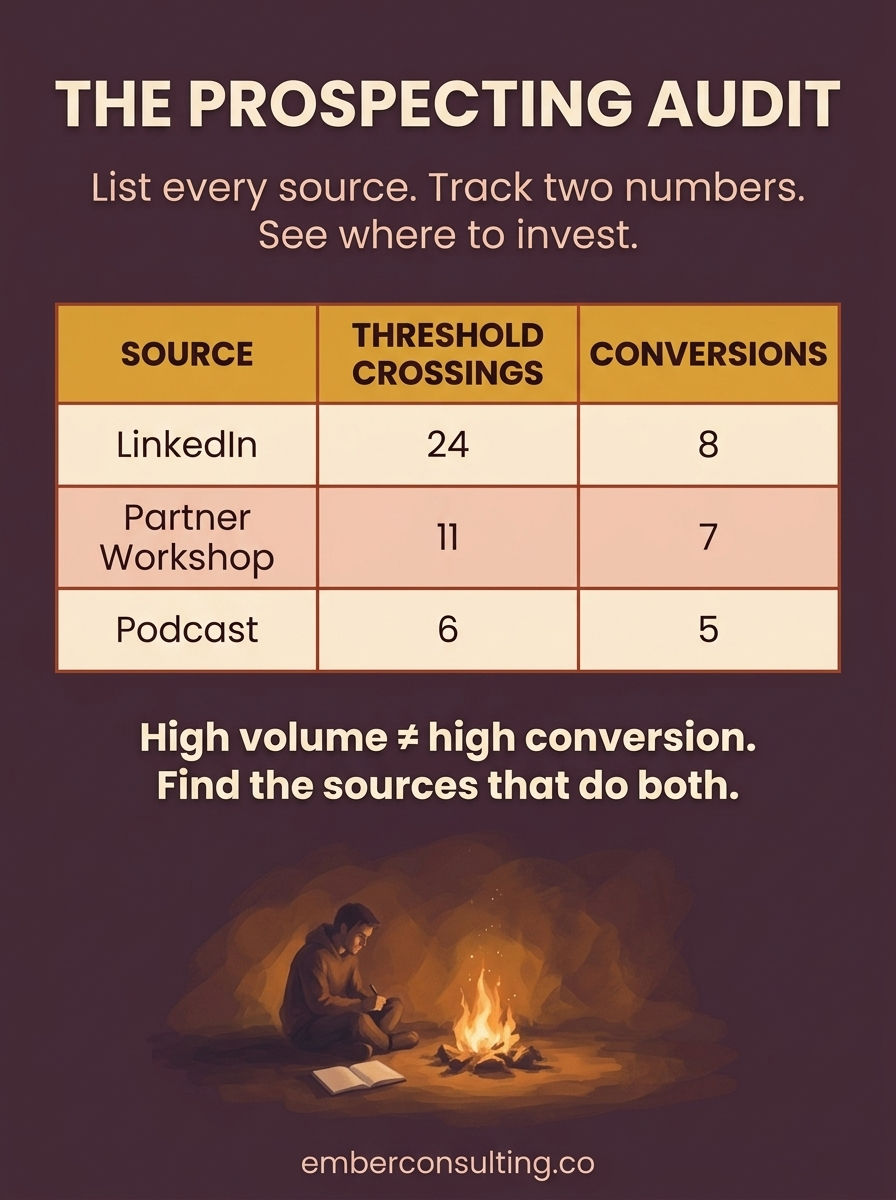
Step 1: List all your sources.
Write down every channel and way people find out about your work or become a member of your community. These are your sources — the places you're sourcing new members from.
Step 2: Track Metric 1 — Threshold Crossings.
For each source, track how many people in the last 12 months crossed the threshold — meaning they took a low-commitment step that indicated genuine interest.
You define what the threshold is. The clearest metric: they booked a discovery call. But it could also be signing up for a free workshop series, or paying a small amount for a specific tool or resource.
One important note: your business runs most smoothly when all prospective clients come in through the same threshold. Pick one, make it consistent, make it trackable.
Then track threshold crossings by source. How many people who found you on LinkedIn booked a call? How many people who attended a partner workshop crossed the threshold?
Step 3: Track Metric 2 — Conversions.
For each source, how many of those people ultimately converted to become paying members?
That's it. Two metrics per source: volume and conversion rate.
Step 4: Analyze.
Once you have both metrics for each source over the last 12 months, the picture becomes very clear:
Which sources bring in the most volume?
Which sources have the highest conversion rates?
Those are not always the same source — and that is extremely valuable information.
The sources with the best combination of both? That's where you invest more time, more energy, and more of your marketing budget. This is how you grow with intention — not just activity.
Growth Is a Derivative of Design
If there's one theme tying this entire season together, it's this:
Community growth is not about luck. It's not about hustle. It's not about ad budgets or viral moments.
It's the result of intentional design.
When your community model is aligned, your member experience is strong, your marketing funnel is clear, and you understand where your best members are actually coming from — growth becomes much simpler.
Not easy. But simple.
And that's the difference.
If you want to go deeper on the Prospecting Audit and the kind of strategic planning work LaToya and I did together, join us at the next Recalibration Intensive. We host these twice a year — it's one full day online, in a small group, building a real plan together.
FAQ: How to Grow Your Community
How do I grow my community and get new members?Sustainable community growth comes from three things: the right foundation (community model, platform, pricing, engagement design), the right funnel (awareness → nurture → close), and the right data (a Prospecting Audit that shows you which sources bring the highest-converting members). Growth tactics alone won't work if any of those foundations are missing.
What is a community marketing funnel?A community marketing funnel has three stages. Awareness is where people discover you and join your audience. Nurture is where they get to know, like, and trust you through content, email, and experiences. The Close is where they decide to become a paying member. Each stage needs at least one tactic done well — not multiple tactics done poorly.
What is a Prospecting Audit for communities?A Prospecting Audit is a simple annual exercise where you track two metrics for each of your marketing channels: threshold crossings (how many people took a low-commitment step indicating genuine interest) and conversions (how many of those people became paying members). The result shows you which sources bring the most volume and which convert best — so you can invest more in what's working.
Why isn't my community growing?Before looking at growth tactics, check four foundations: your community model (is it aligned with your business?), your platform (does it support the member experience you want?), your pricing (is it positioned to attract the right people?), and your engagement design (are your current members actually participating?). Most growth problems trace back to a gap in one of these areas — not a marketing problem.
Should I discount my community to get more members?No. Discounting, free trials, and free limited memberships undermine both the positioning and the commitment level of your community. Price is a signal — too low a price attracts the wrong members and erodes the experience for everyone. Instead, use gateway offers, active lead generators, and special activations to bring people across the threshold at the right commitment level.
What is a gateway offer for a community?A gateway offer is a lower-commitment, lower-cost first step that lets a prospective member experience working with you before joining your full community. The most effective gateway offers are focused on diagnosing a specific problem (not solving everything at once), affordable enough to be an easy yes, easy for you to deliver, and digestible enough for a new client to complete quickly. A well-designed gateway offer dramatically improves conversion rates from discovery to paid membership.

Bri Leever
Bri got her start building a community and growing it to a multi-million dollar revenue stream for a social enterprise in Portland, OR. Now, she supports folks used to running their business on content, coaching, and consulting to create their community offer. She's a Community Strategist by day and a Campervan host by night on the Big Island of Hawaii and you'll usually find her on, in, or under the water.
📹 Youtube
And before you go…
💜 Leave a review on Apple Podcasts
💚 Leave a review on Spotify
❤️ Subscribe on YouTube
That helps the podcast more than you know and I deeply appreciate it. 🙏
*Dear Bri is produced by Ideablossoms.

The point about platform friction killing growth really hit home for me. If the space feels like a chore to manage, you won't be excited to show it off, and that energy absolutely transfers to members. This got me thinking about how much tiny technical friction can drag down the whole experience — I actually stumbled on a free scroll test recently while troubleshooting a janky mouse wheel, and it made me realize how many small annoyances we just accept without checking if it's the tool or the hardware. Being able to quickly rule out device issues before blaming your platform setup feels like the same kind of foundational troubleshooting you're describing here.
test
Is anyone else having trouble with the jalwa game login today, or is it just my account?
testing