
How a $100K/Year Community Migrated to Circle and 7x Engagement Without Losing Revenue

Updated: Aug 31
This article contains affiliate links - when you purchase or subscribe, I earn a commission at no cost to you. Thanks for your support!
Client: Carly Schonberg
Project: Platform Migration, Community Architecture, Launch Strategy
Platform: Circle
Outcomes:
7× the rate of community engagement in the past year on the old platform in just 1 month in the new community
$100K/year revenue preserved
Normal churn maintained
80% projected reduction in site maintenance work in the medium term
When you run a $100k/year community on top of a full-time job, you don’t have hours to waste researching platforms. Carly didn’t. And yet she was stuck.
Carly migrated her entire community to Circle…kept every dollar of recurring revenue stable…and saw more parent engagement in one month than she had in years.
“I knew I needed a new platform, but I didn’t know enough to make the right decision. I didn’t want to spend a lot of money and have it fail.”
Here’s how we did it.
The Challenge: Rebuilding a Community Without Disrupting the Business
Carly Schonberg is a full-stack product design leader based in New York. Alongside her sister, she runs a youth softball training program that generates roughly $100,000/year and supports hundreds of athletes and parents.
For years, their custom-built app served as the home base for training videos and communication. But the technology had reached its limits:
No scalable community features
No migration path for chat history
Frequent bugs and workarounds
No visibility into member behavior
An aging infrastructure that couldn’t evolve
Videos expired due to space and processing constraints. Members often had to download content quickly before it disappeared
At the same time, Carly wanted to deepen connections among families to create a place where parents could support each other and students could grow.
But she was working full-time, managing the business, and building the new community home simultaneously. Researching community platforms became an unexpected burden.
She spoke with several companies. Tested demos. Read reviews. And still wasn’t confident making a decision.
“I didn’t know what I didn’t know, and I didn’t have the time to figure it all out.”
That uncertainty was delaying the entire launch. That’s when she reached out.
The Approach: Clarity, Structure, and a Confident Path Forward
Working together, the focus was simple: reduce complexity, increase clarity, and remove the roadblocks slowing Carly down.
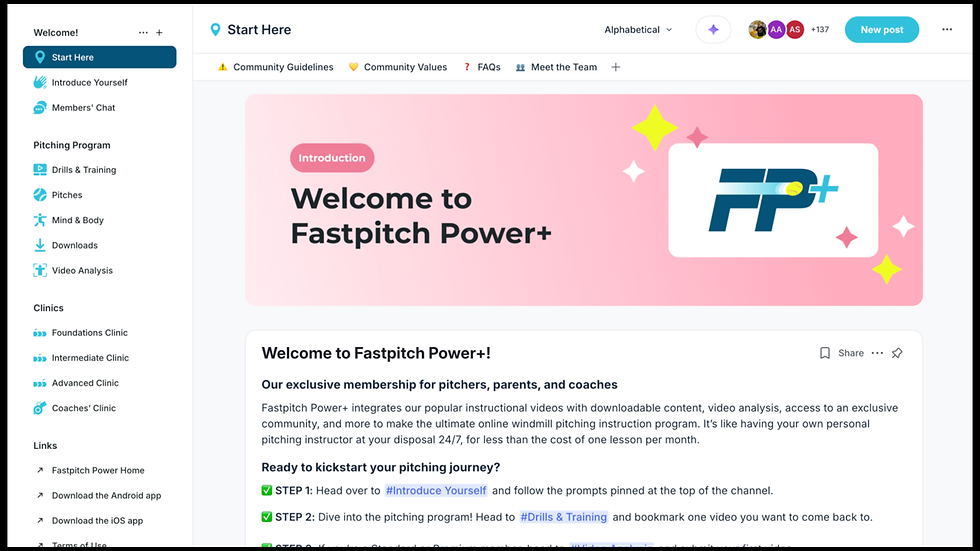
Community Platform Selection
We evaluated the business model, user behavior, content delivery, and long-term scalability. Circle emerged as the strongest choice, offering a clean mobile experience, reliable infrastructure, and a community layer that could grow with them.
“I wouldn’t have made that decision confidently without your expertise.”
Community Architecture
Carly initially envisioned multiple topic-based forums, modeled after a slack-style of conversation organization.But with a lower-engagement audience, that structure risked creating empty spaces.
We replaced that with a single, active chat paired with smart topic organization; a structure that gives the feeling of high energy from day one, even in a small group.
Already in the first month of the Circle community, members have created 20+ posts to engage with each other.
Community Launch Roadmap
A full migration plan was created, including:
Pre-launch checklists
Intro video scripts
Member communication templates
Platform architecture
Every client is a little different, and we knew we wanted to use the majority of our strategy calls, equipping Carly with what she needed around the community platform tech. During strategy calls, we focused on six foundational pillars of launching a healthy community: model, platform selection, platform architecture, platform backend, onboarding strategy, and migration strategy.
This allowed Carly to work in small pockets of time around her full-time job, ticking off one task at a time before our calls (great accountability), while knowing she could tap us in at any time to get direction and questions answered.
“I don’t think I would have launched this year if I’d done it alone.”
Community Decision Support
More than anything, Carly needed a partner she could trust. Someone to validate decisions, simplify options, and eliminate unnecessary work.
“It wasn’t just the time you saved me. I wouldn’t have felt confident in the decision without you.”
The Results: A Smooth Migration and a More Engaged Community
A clean, disruption-free transition
Within days of launching:
~20 members activated immediately
More followed steadily
Revenue remained stable
Normal churn remained unchanged
No unexpected technical issues
For a program generating ~$100k/year, that stability matters.
2. Higher community engagement than expected
Parents who rarely posted online began sharing:
Introductions and members getting to know each other for the first time. Turns out, this sleepy community of busy parents, when invited into a thoughtfully designed home, have a lot to ask and a lot to give. They just didn’t want to do it on Facebook (can you really blame them?).
Stories and accolades about their kids
Requests for help with confidence and mindset
Wins and challenges from practices and games
The previously dormant Facebook group became irrelevant. Families now interact directly inside the app where their lessons live.
3. A scalable foundation
Now, after working with Ember and having overcome the migration, Carly is excited for the list of ideas that have become possible with the move over to Circle, such as:
Creating a leadership journey where athletes can become mentors for newer members
Graduation rituals and senior spotlights celebrating their most successful students
AMAs with their celebrated alum to inspire future students
Parent showcases to highlight the transformation in parents and coaches along the way
These features weren’t possible in the old custom app and it certainly wasn’t going to happen in the Facebook Group. But now, with a warm hub of activity in the Circle community, the sky is the limit for exploring new levels of connection between members.
4. A dramatic reduction in invisible workload
The biggest shift wasn’t weekly hours saved. It was eliminating the massive one-off time burden that would have kept the migration from ever happening. And looking ahead, Carly anticipates an 80% reduction in site maintenance work because Circle removes so much of the technical overhead.
Time that goes back to:
running the business
serving students
removing friction for families
Insights: What This Platform Move Revealed
Launching a community requires more than choosing a platform. It requires clarity about:
What members actually need
How much structure the team can maintain
How to keep things simple without losing value
Carly put it best:
“The platform choice, the structure, the confidence. I wouldn’t have arrived at any of it on my own.”
FAQ: Circle Migration for Communities
Q: How do you migrate a community to Circle without losing members?
A: Retention stays stable when members know what’s happening, why it’s happening, and exactly what to do. A smooth migration includes:
– a clear communication timeline
– a structured onboarding path
– a platform that’s fully prepared before the move.
You can also explore the platform comparison resources to understand what makes Circle a strong migration choice.
Q: Is Circle good for youth sports or training programs?
A: Yes. Especially for programs like Fastpitch Power where parents and athletes need simple, mobile-first access to communication, training content, and announcements. Circle works best when you want:
– clean organization
– direct communication
– a community layer that encourages parent-to-parent connection.
Listen to these Dear Bri episodes:
Q: What’s the biggest risk during a community migration?
A: The biggest risks are unclear communication, disjointed onboarding, and moving members before the new platform is ready. These create confusion and decrease trust, which can increase churn. When the migration strategy is clear and structured, retention usually stays level — just like Fastpitch Power experienced.
Ready to Build a Community That Inspires Connection?
If you’re ready to create a space that fosters genuine connection and lasting impact, I can’t recommend Bri enough. Set up a free Discovery Call today to see if her services could be a good fit for you.
Join the Fireside Monthly(ish) Newsletter from Ember
Join the Ember Intensives
Full day Intensives for community-powered businesses.
January 27th 2026
Early April 2026
End of September 2026


Comments